What Is That Loud Banging Noise in the Laundry Room?
Are you trying to figure out why your pipes bang when the washing machine stops filling? You are certainly not alone. Many homeowners are caught off guard when they start a load of laundry, walk into the next room, and suddenly hear a loud, violent thud echoing from inside the walls. That alarming sound is not just a harmless quirk of an older house; it is a well-documented plumbing phenomenon known as water hammer, or hydraulic shock. Every time you hear that distinct banging, your home’s plumbing infrastructure is undergoing a severe mechanical stress test.
Water hammer occurs because the heavy, fast-moving column of water traveling through your pipes is forced to stop instantly, sending a violent shockwave crashing against the pipe walls and joints. Over time, this repeated impact degrades your system. Addressing this issue requires professional plumbing to evaluate the stress on your system and potentially perform water leak repair if joints have already been compromised by the repeated force.
The Physics Behind the Bang: Understanding Hydraulic Shock
To truly understand why your pipes sound like they are being hit with a mallet, it helps to look at the fluid dynamics happening behind your drywall. Water is heavy—it weighs about 8.3 pounds per gallon. In a standard residential plumbing system, this heavy liquid travels through your pipes at a rate of 4 to 8 feet per second. That creates a significant amount of kinetic energy.
When a valve closes slowly, the water gradually decelerates, and the kinetic energy safely dissipates. However, when the flow is stopped instantly, all that forward momentum has absolutely nowhere to go. The water crashes into the closed valve, instantly converting its kinetic energy into a massive pressure spike. This sudden surge can reach up to 60 times your normal municipal water pressure.
The Backward Shockwave
Because water cannot be compressed, that massive pressure spike rebounds off the closed valve and travels backward through your plumbing system at the speed of sound. As this invisible shockwave races through the lines, it forces the pipes to expand slightly and violently jerk sideways. If the pipes are not strapped down tightly every few feet, they will physically strike the wooden framing of your house, other pipes, or the drywall itself. That physical impact is the loud bang you hear.
| Condition | Water Speed | System Pressure | Pipe Impact |
|---|---|---|---|
| Normal Flow | 4 to 8 feet per second | 40 to 60 PSI | Silent, stable flow |
| Hydraulic Shock | Instant stop (0 ft/s) | Up to 60x normal PSI | Violent expansion and structural striking |

Why Modern Washing Machines Trigger the Loudest Bangs
You might wonder why the laundry room seems to be the epicenter of this problem, while turning off the kitchen sink rarely causes a bang. The answer lies in the specific technology used in today’s appliances. Older plumbing fixtures and manual faucets require you to physically turn a handle, which gradually restricts the water flow over a second or two. This gradual closure gives the water time to slow down safely.
In contrast, your laundry appliance relies on washing machine fast-acting solenoid valves. A solenoid valve is an electromagnetic gate that controls the water flow. When the machine’s internal computer determines that the tub has reached the precise water level needed for the cycle, it cuts the electrical current to the solenoid.
The Cost of High Efficiency
When that current is cut, a spring-loaded mechanism snaps the valve shut in a fraction of a second. This instant closure is necessary for the appliance’s highly sensitive electronic water level sensors to function correctly, especially in modern high-efficiency (HE) machines that use precise pulses of water. While this rapid-fire action is great for water conservation, it is absolutely brutal on unprotected plumbing.
Common appliance behaviors that cause shock:
- Short fill bursts: HE machines pulse water in short bursts to saturate clothes, causing multiple loud bangs in a row.
- Hot/cold mixing: The machine rapidly toggles between the hot and cold lines to achieve the perfect wash temperature, sending shockwaves down both lines.
- Instant shutoff: The final fill cycle ends abruptly, sending the largest shockwave back toward your water heater or main line.
It is important to realize that the washing machine itself is not broken. The appliance is operating exactly as designed. The problem is that the home’s plumbing infrastructure simply lacks the necessary shock absorption to handle modern valve technology.
The Hidden Danger to Aging Copper and Galvanized Pipes
Not all homes react to hydraulic shock in the same way. The severity of the damage depends heavily on the materials used behind your walls. Modern flexible piping, such as PEX, has a slight ability to expand and absorb a small portion of the pressure spike. However, older homes in Snellville and the greater Georgia area frequently feature aging copper or galvanized steel plumbing systems, which are highly susceptible to this specific type of joint stress.
Rigid metallic pipes cannot expand to absorb the sudden surge in pressure. Instead, the entire force of the shockwave is transferred directly to the weakest points in the system: the joints, elbows, and connections. Every time you hear that loud bang, those connections are being stretched, pulled, and stressed.
The Cumulative Effect of Mechanical Stress
Think of bending a metal paperclip back and forth. Doing it once or twice won’t break the metal, but repeating the motion dozens of times eventually causes it to snap. The same principle applies to your plumbing. Repeated hydraulic shock weakens soldered copper joints and degrades the threaded connections on galvanized pipes over time. The banging noise is not just a nuisance; it is an active warning sign of cumulative damage. Ignoring the sound means allowing that mechanical stress to continue until a joint finally gives way.
The Threat of Micro-Fractures Behind Your Walls
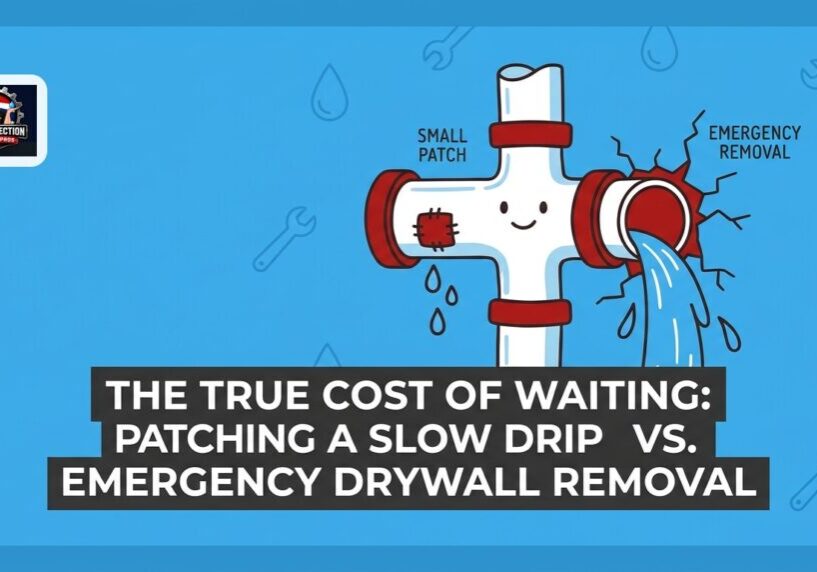
Catastrophic pipe bursts rarely happen without warning. Long before a pipe completely separates and floods a laundry room, it usually develops tiny, invisible micro-fractures at the stressed joints. This is where water hammer transitions from a noisy annoyance to a serious threat to your property.
The Problem: Silent Seepage
When a soldered joint is repeatedly battered by hydraulic shock, microscopic cracks begin to form. These micro-fractures leak incredibly slowly—sometimes just a few drops an hour—directly inside your dark, unventilated wall cavities. Because the leak is hidden behind drywall or cabinetry, you will not see a puddle on the floor. Instead, the water slowly saturates the wood framing and insulation, creating the perfect environment for toxic black mold, structural wood rot, and severe pest infestations.
The Cause: Untreated Hydraulic Shock
If your pipes have been banging for months or even years, there is a strong possibility that micro-fractures have already begun to form. The continuous pressure spikes ensure that these tiny cracks will only widen over time, eventually leading to a major blowout if the root cause is not addressed.
The Solution: Proactive Detection
This is where proactive intervention becomes critical. Leak Detection Service Pros specialize in utilizing advanced acoustic and thermal technology to pinpoint these early-stage micro-fractures non-invasively. By identifying the exact location of a hidden leak without tearing open drywall, you can address the damage caused by water hammer before it escalates into a catastrophic structural issue. If you suspect your banging pipes have already caused unseen damage, scheduling hidden leak detection is the smartest protective measure you can take.
Why Pre-Winter Temperature Drops Escalate the Risk
The risks associated with water hammer increase significantly as the seasons change. As November brings pre-winter temperature drops to Georgia, the physical properties of your plumbing system begin to shift. The physics of thermal contraction dictate that as temperatures fall, pipe materials naturally contract and stiffen.
When rigid metal pipes contract during cold autumn nights, the tension on every soldered joint and threaded connection increases. If those joints have already been weakened by months of repeated hydraulic shock from your washing machine, they are highly susceptible to sudden failure during this contraction phase. A joint that was barely holding on during the warm summer months can easily snap when subjected to the combined stress of cold-weather contraction and a 60x pressure spike.
This makes November pre-winter plumbing readiness incredibly important. Resolving water hammer issues before the freezing weather sets in is a critical step in protecting your home. Furthermore, securing your plumbing integrity now ensures your system can handle the added strain of holiday hosting, when washing machines, dishwashers, and showers see much heavier use.
Professional Solutions: Arrestors and System Protection
Fortunately, there is a definitive, code-compliant solution to eliminate hydraulic shock and protect your aging pipes. The most effective way to neutralize the pressure spikes caused by washing machine fast-acting solenoid valves is to install water hammer arrestors.
A water hammer arrestor is a small, specialized device that acts as a shock absorber for your plumbing system. It consists of a sealed air chamber and a watertight piston. Because air can be compressed (unlike water), the arrestor provides a cushion for the kinetic energy. When the washing machine valve snaps shut, the backward-traveling shockwave hits the arrestor, pushes the piston up, and compresses the air inside the chamber. This safely dissipates the pressure spike before it can rattle your pipes or stress your joints.
Why professional installation is mandatory:
- Cutting into supply lines: Installing arrestors correctly requires cutting into the existing copper or galvanized water lines, which must be done precisely to prevent leaks.
- Proper sizing and placement: Arrestors must be sized correctly based on the fixture’s flow rate and placed at specific distances from the quick-closing valve to be effective.
- System-wide evaluation: A professional plumber will also check your home’s incoming municipal water pressure, as a failing pressure reducing valve (PRV) can make water hammer exponentially worse.
By relying on an expert for installing water hammer arrestors, you ensure that the shockwave is permanently resolved, potentially saving yourself from extensive drywall and framing repairs in the future.
Frequently Asked Questions About Washing Machine Water Hammer
Before we answer the most common questions about hydraulic shock, remember that prolonged banging often points to weakened joints that may eventually require professional water line repair if left unaddressed.
Is it normal for pipes to bang when the washing machine stops?
While common, it is not “normal” or safe for the plumbing system to bang loudly. The noise indicates a complete lack of proper shock absorption for the washing machine’s fast-acting valves. Over time, this abnormal stress will degrade the integrity of your plumbing connections and can lead to severe leaks.
Can water hammer cause a hidden leak?
Yes, repeated water hammer frequently causes hidden leaks behind walls and ceilings. The immense pressure spikes weaken soldered pipe joints and threaded connections over time, leading to tiny micro-fractures. These fractures slowly leak water into wall cavities, causing structural rot and mold long before the damage becomes visible.
Why does the washing machine valve cause water hammer?
Washing machines use fast-acting solenoid valves that shut off the water supply instantly. This instant closure forces rapidly moving water to stop abruptly, leaving the kinetic energy nowhere to go. The resulting energy conversion creates a severe hydraulic shockwave that travels backward through the pipes.
Will water hammer burst a pipe?
Yes, untreated water hammer can eventually burst a pipe. The cumulative mechanical stress acts like bending a piece of metal back and forth until it breaks. Weakened joints or older rigid pipes can fail entirely under the pressure, resulting in catastrophic flooding and severe property damage.
How do I stop my pipes from banging when the washing machine is on?
The most effective way to stop the banging is to have a professional plumber install water hammer arrestors near the appliance valves. Checking the municipal water pressure and securing loose pipe straps can also mitigate the noise, but arrestors are the only code-compliant way to address the root cause of the hydraulic shock.
What is the difference between water hammer and loose pipes?
Water hammer is a violent pressure shockwave that occurs immediately after a valve closes, while loose pipes are a structural support issue. Water hammer causes a sharp, distinct bang or thud when the water stops. In contrast, loose pipes may rattle, hum, or vibrate continuously while the water is actively flowing through them.
Can high municipal water pressure make water hammer worse?
Yes, excessively high incoming water pressure amplifies the physical force of hydraulic shock. If a home’s baseline water pressure exceeds 80 PSI, the water is already moving too fast through the system. When a fast-acting valve closes against that high baseline pressure, the resulting shockwave will be significantly more violent and destructive.
Secure Your Plumbing System Against Hydraulic Shock
Banging pipes in the laundry room are far more than just a noisy appliance issue; they are a clear warning sign of severe mechanical stress on your home’s infrastructure. Every time that fast-acting valve snaps shut, the resulting shockwave puts your aging copper and galvanized joints at risk of micro-fractures and hidden leaks.
As part of your November pre-winter plumbing readiness, it is vital to address this stress before cold-weather contraction makes your pipes even more brittle. Don’t wait for a joint to fail entirely. Schedule a professional inspection to evaluate your hidden leak risks and have proper water hammer arrestors installed, ensuring your plumbing remains quiet, secure, and fully protected all season long.
Recent Posts