The Trillion-Gallon Problem Hiding Under Your Feet
Nearly one trillion gallons of water are wasted nationwide every year due to household leaks, making proactive leak detection an urgent priority for homeowners. According to the Environmental Protection Agency, ten percent of homes have hidden leaks that waste ninety gallons or more every single day. Most of this water disappears completely unnoticed, soaking into the ground under foundations or evaporating behind drywall before visible damage occurs.
Maintaining a healthy plumbing system requires constant vigilance, especially as the seasons change. Here in Snellville GA, the shift toward late fall brings unique stresses to underground pipes. A slow drip that seems harmless in the summer can easily escalate into a major plumbing disaster once temperatures drop.
Many homeowners dread the idea of looking for a water leak because they associate it with torn-up yards and broken drywall. The good news is that professional leak detection has evolved into a modern, stress-free process. By utilizing advanced technology, specialists can pinpoint the exact location of escaping water without causing unnecessary damage to your property. Catching these hidden issues during the October pre-winter season ensures your home remains safe, dry, and structurally sound before the freezing weather arrives.
Top Signs You Have a Hidden Plumbing Leak
Because most of your home’s water lines run behind walls, under floors, or beneath the ground, spotting a problem isn’t always as simple as seeing a dripping faucet. Identifying the early warning signs allows you to schedule residential leak detection before a minor drip turns into a catastrophic failure. Here are the most common indicators that water is escaping somewhere inside your home.
- Unexplained spikes in water usage: If your monthly water bill suddenly jumps but your household consumption habits haven’t changed, a hidden leak is the most likely culprit.
- Musty odors or visible mold: Water leaking inside a wall cavity creates the perfect dark, damp environment for mold and mildew. A persistent musty smell or sudden dark spots on baseboards should never be ignored.
- Warm spots on the floor: If you step barefoot onto a section of your floor that feels unusually warm, you are likely dealing with a hot water slab leak. This happens when the hot water line running beneath your concrete foundation develops a crack.
- The sound of running water: Hearing a faint hissing or running water sound when the washing machine is off and no faucets are running is a strong indicator of a pressurized pipe leak.
- Decreased water pressure: A significant drop in water pressure across multiple fixtures often means water is escaping the main supply line before it ever reaches your faucets.
Monitoring Your Water Meter
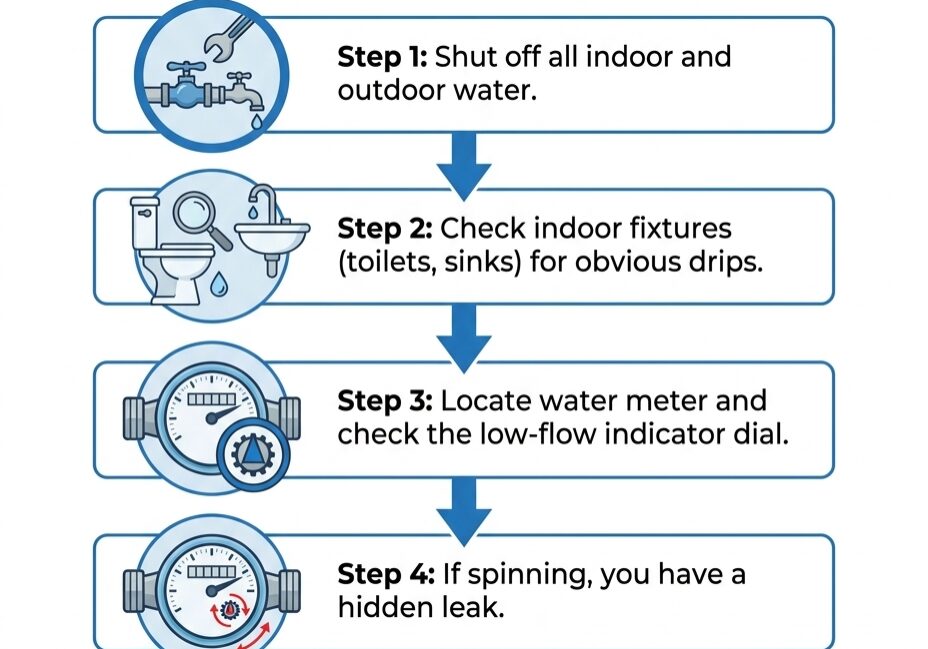
If you suspect a problem but cannot see any physical evidence, a simple water meter test is the best way to confirm your suspicions. First, ensure that all water sources inside and outside the house are completely turned off. This includes dishwashers, washing machines, and automated irrigation systems. Next, locate your main water meter and check the leak indicator dial—often a small triangular or star-shaped wheel. If this dial is spinning while all water is shut off, you have an active leak. For a slower drip, write down the current meter reading, wait two hours without using any water, and check the reading again. If the numbers have increased, water is escaping somewhere on your property.

Why Fall is the Critical Time for Plumbing Inspections
Timing matters when it comes to home maintenance. The transition period in October pre-winter is the most critical window for identifying and resolving plumbing vulnerabilities. Throughout the hot, humid summer months, the ground around your home endures intense heat and occasional drought conditions. This bakes the soil, causing it to harden and shift, which puts immense stress on the underground pipes supplying water to your home.
As late fall arrives and the climate shifts toward impending winter freezes, those stressed pipes face a new threat: severe temperature contraction. When the ground temperature drops, both the soil and the pipe materials physically contract. If a pipe has already been weakened by summer shifting, or if it currently has a microscopic pinhole leak, this contraction can be the breaking point.
The real danger occurs when freezing temperatures hit. Water expands as it turns to ice. If a hidden micro-leak allows water to pool around a pipe, that surrounding water will freeze, expanding and exerting massive exterior pressure on the plumbing line. Simultaneously, water freezing inside the pipe pushes outward. This perfect storm of pressure can turn a tiny, unnoticeable drip into a catastrophic pipe burst overnight. Proactive fall maintenance acts as a protective shield for your home’s infrastructure. By locating and repairing weak points before the first freeze, you eliminate the risk of waking up to a flooded basement or a flooded yard in the middle of January.
The Hidden Danger of Expansive Clay Soils
Understanding your local geography is a crucial part of protecting your home. In Snellville GA and across much of the region, homes are built on expansive red clay soil. This specific type of soil is highly reactive to moisture changes, creating a unique and severe hazard when hidden plumbing leaks occur.
Expansive clay soil acts much like a dense sponge. During dry periods, it shrinks and cracks. However, when an undetected underground leak begins releasing water into the ground, the clay absorbs that moisture and swells significantly. This swelling process generates tremendous upward and lateral pressure against anything in its way—including your home’s concrete slab and foundation walls.
As the leak continues to saturate the earth, the expanding soil forces the concrete slab upward, a process known as foundation heaving. You might start to notice doors that suddenly stick in their frames, diagonal cracks forming in your drywall, or uneven spots in your flooring. Because the heavy autumn rains already add moisture to the ground, introducing an artificial water source from a broken pipe accelerates this expansion dramatically.
The longer the leak goes undetected, the more unstable the soil becomes. Eventually, the pressure forces the foundation to crack, compromising the structural integrity of the entire house. Finding these leaks early stops the cycle of soil expansion and contraction, saving homeowners from massive structural repair bills down the road.
Commercial vs. Residential Leak Vulnerabilities
While the fundamental physics of water leaks remain the same, the scale and impact differ significantly depending on the type of property. Both homeowners and business owners face unique challenges when water escapes their plumbing networks, but the stakes often multiply in a commercial setting.
Residential plumbing layouts are generally straightforward, utilizing standard pipe sizes and operating at moderate municipal water pressures. A leak in a home is certainly destructive, but it is usually localized to a specific branch line, a bathroom, or a single main supply line. In contrast, complex commercial systems involve massive networks of large-diameter pipes, specialized industrial fixtures, and multiple water zones spread across extensive square footage.
| Feature | Residential Plumbing | Commercial Plumbing |
|---|---|---|
| Water Pressure | Moderate (40-80 PSI) | High (often exceeding 100 PSI) |
| System Complexity | Straightforward, single-family layout | Complex, multi-story, multi-zone networks |
| Leak Impact | Property damage, high utility bills | Massive property damage, business interruption |
| Detection Challenge | Usually isolated to a few key areas | Requires scanning massive square footage |
Because commercial properties often operate with much higher water pressure, a pipe failure releases a substantially larger volume of water in a fraction of the time. This makes commercial leaks highly destructive. Furthermore, unaddressed water damage in a business environment leads to severe business interruption costs. Shutting down a retail space, restaurant, or office building for emergency water extraction results in lost revenue, displaced employees, and frustrated customers.
Fortunately, the same non-invasive principles used in homes apply to commercial leak detection, just on a much larger scale. Specialized equipment can trace lines through concrete parking decks, under warehouse floors, and behind commercial facility walls without disrupting daily business operations.
Say Goodbye to ‘Search and Destroy’: Modern Leak Detection Methods
Historically, finding a hidden pipe leak was a stressful and destructive process. Plumbers relied on the “search and destroy” method, which involved breaking through drywall, tearing up expensive hardwood floors, or excavating deep trenches in the yard just to find the source of the moisture. Today, that approach is entirely obsolete. As dedicated Leak Detection Service Pros, the focus is exclusively on using non-invasive leak detection technology to protect the homeowner’s property while pinpointing the exact location of the issue.
Modern detection relies on advanced scientific instruments that see and hear what the human senses cannot. Here is how specialized technicians locate hidden moisture without swinging a single sledgehammer:
- Acoustic Sensor Technology: Water escaping from a pressurized pipe creates a distinct, high-frequency hissing sound. Technicians use highly sensitive ground microphones and acoustic listening discs to amplify these sounds through concrete slabs, soil, and flooring. By measuring the frequency and volume of the sound waves, they can pinpoint the exact spot where the pipe is compromised.
- Thermal Imaging Cameras: Hidden moisture alters the temperature of the building materials around it. Thermal imaging uses infrared cameras to scan walls, ceilings, and floors for temperature anomalies. A hot water leak will glow brightly on the camera’s display, while a cold water leak will show up as a distinct dark, cool patch behind the drywall.
- Tracer Gas Testing: For microscopic leaks that are difficult to hear, technicians drain the water from the suspected plumbing line and introduce a safe, inert mixture of hydrogen and nitrogen gas. Because hydrogen molecules are incredibly small, they escape through the tiny crack in the pipe and rise vertically through the soil or concrete. Specialized gas sniffers then detect the exact location where the gas breaches the surface.
By relying on these advanced methods, a professional assessment in Snellville GA provides precise answers without causing a single scratch to your home’s finishes.
What to Expect During a Professional Leak Assessment
If you have never scheduled a professional leak evaluation before, you might be unsure of what happens during the appointment. Understanding the systematic process helps set clear expectations and provides peace of mind that your property is in expert hands.
The process always begins with an initial consultation and a thorough review of your water usage. The technician will ask about any symptoms you have noticed, such as sudden drops in water pressure, unusual sounds, or the appearance of mold. They will also review your recent water bills to gauge the severity and volume of the suspected leak.
Next, the technician performs a systematic isolation of your plumbing lines. By manipulating specific valves, they can determine whether the leak is located on the hot water side or the cold water side of your system. They will also isolate the interior plumbing from the exterior irrigation and main supply lines. This step narrows down the search area significantly.
Once the general area is identified, the deployment of non-invasive equipment begins. The technician will use acoustic sensors, thermal imaging, or tracer gas to scan the isolated zone. They will map the exact path of the underground or hidden pipes and pinpoint the precise origin of the escaping water.
Finally, the assessment concludes with the delivery of a comprehensive report. This document details the exact location of the leak, the suspected cause, and a recommended strategy for repair. Armed with this accurate information, you can proceed with targeted repairs rather than paying for exploratory demolition.
Protect Your Home Before Winter Arrives
The health of your plumbing system directly impacts the safety and structural integrity of your entire home. As October pre-winter conditions set in, the window for proactive maintenance begins to close. Catching a hidden water issue now ensures that dropping temperatures won’t turn a manageable repair into an emergency pipe burst.
Remember that modern detection methods mean finding the problem doesn’t have to ruin your floors, your walls, or your yard. The technology exists to find the exact location of the drip silently and safely. If you have noticed unexplained spikes in your water bill, warm spots on your floor, or the faint sound of running water, do not wait for the freeze to hit. Schedule a thorough evaluation for professional leak detection today and enjoy the peace of mind that comes with a secure, watertight home.
Frequently Asked Questions
How do professionals detect hidden water leaks?
Professionals detect hidden water leaks using advanced, non-invasive technology rather than breaking open walls or floors. They rely on acoustic listening devices to hear the high-frequency sound of escaping water, thermal imaging cameras to spot temperature changes caused by moisture, and safe tracer gases to locate microscopic cracks under concrete slabs. This combination of tools allows them to pinpoint the exact location of a leak accurately and safely.
What are the early signs of a hidden plumbing leak?
The earliest sign of a hidden plumbing leak is usually an unexplained increase in your monthly water bill. Other common indicators include a persistent musty odor, the sudden appearance of mold or mildew on baseboards, warm patches on your flooring, and the faint sound of running water when all appliances and faucets are completely turned off. Paying attention to these subtle changes can save your home from extensive water damage.
How can I tell if I have a leak underground?
You can often tell if you have an underground leak by looking for unusual changes in your yard or foundation. Watch for patches of grass that are suddenly much greener or faster-growing than the surrounding lawn, persistently muddy areas even when it hasn’t rained, or deep structural cracks forming in your driveway or foundation. Performing a simple water meter test while all water is shut off will also confirm if water is escaping underground.
What is the best water leak detector for a slab foundation?
The best water leak detector for a slab foundation is a professional-grade acoustic listening device paired with thermal imaging. Acoustic sensors allow technicians to hear the exact frequency of water escaping under heavy concrete, while thermal cameras can easily identify the warm spots created by a broken hot water line. For very small pinhole leaks under a slab, tracer gas equipment is considered the most accurate detection method available.
How do you find a water leak behind a wall without breaking it?
To find a water leak behind a wall without breaking it, technicians use thermal imaging cameras and specialized moisture meters. The thermal camera scans the drywall and detects the temperature anomaly created by the hidden water, showing a distinct cold or hot spot on the screen. Moisture meters are then pressed against the surface of the wall to measure the exact humidity level of the building materials, confirming the presence of water without causing any physical damage.
Does expansive clay soil cause plumbing leaks?
Yes, expansive clay soil is a leading cause of underground plumbing leaks. When this type of soil absorbs moisture, it swells dramatically, and when it dries out, it shrinks. This continuous cycle of expanding and contracting exerts massive physical pressure on the underground pipes supplying water to your home, eventually causing them to shift, bend, and crack under the strain.
Recent Posts